Monday, 16 March 2015
New vs Old games journalism
Games journalism began in the same manner as most other journalism; very fact filled, focusing on the mechanics of a game and how it plays, and that's about it. By the early eighties, it had flipped to more magazine like proportions, with the majority of popular games journalism being both written and viewed by games' major market; young adults.
After that there was a downturn in games journalism across the pond, but it stayed strong in Europe, and in the nineties came the internet. Once again, a new form of journalism arose, and journal articles on gaming were like streams of consciousness on screen, written by the same people that went on to become major gaming publications like IGN and PC Gamer.

Joystick Generation
IN the final installation of the series wooley looks at Video Games.
Wooley starts by discussing the revolutionary games of the 80s like Elite, a trading game set in space with what was then phenomenal 3D graphics and brings us on a journey through the ages, looking at influential games such as Tomb Raider with it's iconic character Lara Croft and a handful of other classic video games from the 90s.
The journey continues on to the present game with possibly one of the most controversial games ever made Grand Theft Auto. The series ends with a mention of MMORPGs, games such as World of Warcraft and Runescape where the player is in control of a digital avatar in a parallel, digital realm filled with other players.
Wooley starts by discussing the revolutionary games of the 80s like Elite, a trading game set in space with what was then phenomenal 3D graphics and brings us on a journey through the ages, looking at influential games such as Tomb Raider with it's iconic character Lara Croft and a handful of other classic video games from the 90s.
The journey continues on to the present game with possibly one of the most controversial games ever made Grand Theft Auto. The series ends with a mention of MMORPGs, games such as World of Warcraft and Runescape where the player is in control of a digital avatar in a parallel, digital realm filled with other players.
Games Britannia: “Monopolies & Mergers”
Part two of game Britannia started by explaining a game from the 18th-19th century called the mansion of bliss. This game was made to get more children into school the whole aim is to reach the middle of the board which had a huge Georgian house. It was a way of telling the lower/middle class that you can aspire to more in life if you behave proper.
After success in the UK the mansions the game was copied in America, however there were some changes made, instead of a nice Georgian house at the end it was replaced by president of a company. It was telling you to work hard and you will become rich. You could say the american dream come from this morality based game by saying to win you need to be rich you need to be powerful.
In this episode they also talked about a game called br'er fox and br'er rabbit this was a game made to raise debate about redistribution of wealth from land owners. It helped raise debate about a sensitive subject by making a safe setting your disconnected from the subject your just playing a game. From this game we ended up with a classic board game monopoly.
After success in the UK the mansions the game was copied in America, however there were some changes made, instead of a nice Georgian house at the end it was replaced by president of a company. It was telling you to work hard and you will become rich. You could say the american dream come from this morality based game by saying to win you need to be rich you need to be powerful.
In this episode they also talked about a game called br'er fox and br'er rabbit this was a game made to raise debate about redistribution of wealth from land owners. It helped raise debate about a sensitive subject by making a safe setting your disconnected from the subject your just playing a game. From this game we ended up with a classic board game monopoly.
Expanded Bibliography
Brathwaite, B. and Schreiber, I. (2009). Challenges for game designers. Boston, Mass.: Charles River Media, a part of Course Technology.
scott jon siegel, (2007). How to write rules (without confusing people).. [online] Available at: http://numberless.net/blog/2007/04/09/how-to-write-rules-without-confusing-people/ [Accessed 16 Mar. 2015].
Short, E. (2015). Opinion: Why Time-Management Games Ought To Be Great At Story-telling (And Why They Mostly Aren't). [online] Gamasutra.com. Available at: http://www.gamasutra.com/view/news/18769/Opinion_Why_TimeManagement_Games_Ought_To_Be_Great_At_Storytelling_And_Why_They_Mostly_Arent.php [Accessed 16 Mar. 2015].
Trefry, G. (2010). Casual Game Design. Burlington: Elsevier.
Wabshall, M. (2015). ‘Come Out Come Out, Where Ever You Are’. Casual Connect Magazine, pp.36-38.
Sunday, 15 March 2015
Design Document
The Royal Game of Ur 2.0
Scenario
The Royal Game of Ur 2.0 is a four player game aimed at males between 8-18 turn based race game where each player has to navigate factions of their army across the battlefield while avoiding or fighting their opponents armies. A fight takes place when two or more factions land on the same square, the fight is decided by a dice throw where the losers faction removed from the board. The object of the game is to get all of your factions across the battlefield.
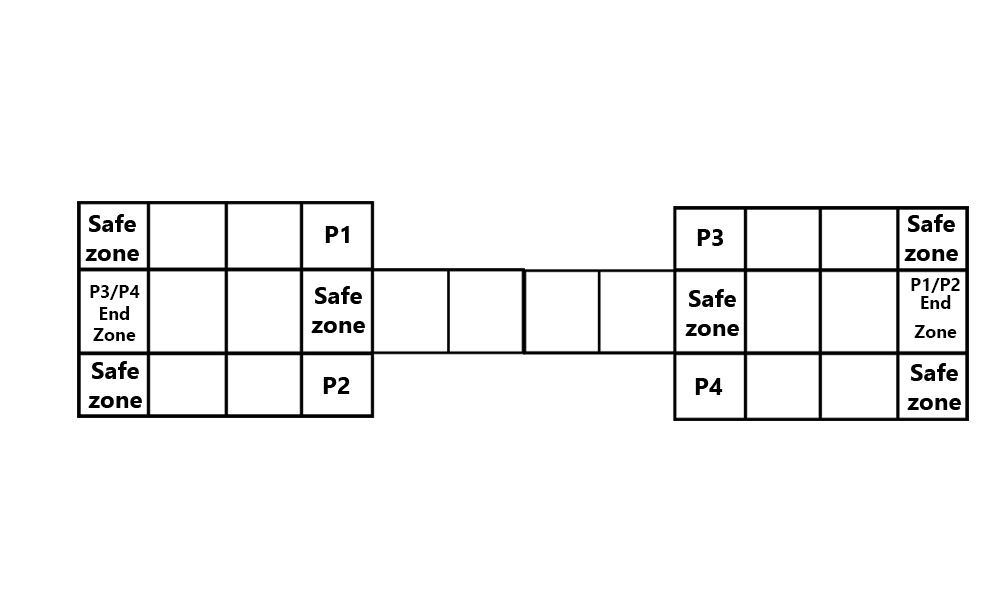
Board Design
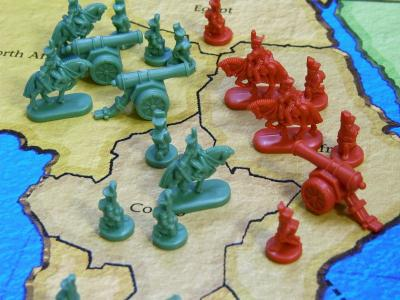
 Since the game is based on armies moving on a battlefield the game board should have a design similar to risk looking like a map to show the armies moving from one area to another, the board should not show as much of the world map as it does in risk though. The board would be made of cardboard so that it can be folded up as it would be too large to store not folded.
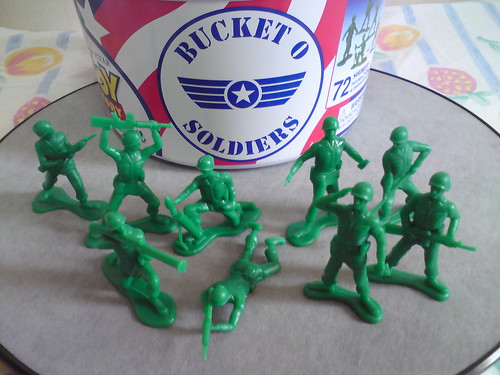
When thinking of what the pieces should look like i thought about what the type of game is, since the game has battle elements and is based around moving troops along the board i decided that the pieces should look like soldiers, i then did some research into toy soldiers, i looked at the real life versions of the toy soldiers in Toy Story as i think they looked the best quality and they had the most variety of types of soldier. I chose soldiers as this ties in with the theme of the game. The pieces should be made of plastic so they're durable, easy to make and easy to replace if any pieces are lost or broken. The pieces should vary in appearance with each player getting 5 sets of 2 different solders, this again represents the fact that the player is controlling a whole army. The pieces should have good detail on things like their clothing faces and any weapons they have
Asset List
1x Box
1x Instructions
1x Game Board
4x 6 sided Dice
4x 6 sided Dice
10x Black soldier pieces
10x White soldier pieces
10x Red soldier pieces
10x Green soldier pieces
Rules
- The winner of the game is the first person to get all of his/her pieces off of the board.
- All players must start with all of their pieces off of the board.
- All players roll a dice, the player that goes first is decided by which player rolls the highest number, if two players roll the same number both players roll again.
- Play goes around the board anticlockwise.
- Each player's turn consists of one dice roll.
- At the start of their turn the player whose turn it is rolls the dice.
- If you have no pieces on the board you must roll to get one of your pieces onto the board, this throw also counts to how far the piece moves along the board , for example if you roll three you would move one of your pieces onto the board and also move that piece two spaces.
- If you already have a piece on the board you can also choose to add another piece
- You may move multiple pieces per turn, however putting a new piece onto the board takes one move.
- You cannot stack counters
- You cannot be attacked while in a safe zone
- If your roll would put you onto a pre-occupied safe zone you must land on the space before the safe zone, you may use remaining moves to move other pieces.
- If two players land on the same square a dice is rolled to decide the outcome of the battle, the loser of the battle removes their piece from the board, they must then roll again to get the piece back onto the board
- If both players roll the same number in a battle then the roll is re-done.
- You must roll the exact number to get your piece off the board
Referances
Siegel, Scott Jon. 'How To Write Rules (Without Confusing People).'. scott jon siegel. N.p., 2007. Web. 02 Mar. 2015.
Museumofplay.org,. N.p., 2015. Web. 02 Mar. 2015.
Images
Toy Soldiers




Risk board

http://cf.geekdo-images.com/images/pic1048787_md.jpg
Missed opportunities (Parlett workshop)
UCS ran a Games Workshop for all years hosted by David Parlett. Who is most known for his "Spiel des jahres" game Hare and Tortoise which is a non traditional race game where instead of rolling a dice to move forward you spend carrots and earn them to propel you round the board whilst also trying to get rid of a lettuce cards.Dave Parlett has won many other awards including the Spiel Des jahres (game of the year) in 1979.
Unfortunately I missed this session that was run as i was ill and subsequently missed out on what I saw as a great opportunity to gain valuable information surrounding games design and the opportunity to learn a great deal from David Parlett.
Unfortunately I missed this session that was run as i was ill and subsequently missed out on what I saw as a great opportunity to gain valuable information surrounding games design and the opportunity to learn a great deal from David Parlett.
What the hell is going on ?? (La decima vittima)
La Decima Vittima translates from Italian into English as (The 10th Victim) The movie was in Italian with English subtitles. The plot of the movie is a about the contestants on a TV show of some kind in what is basically a pervasive game of assassination but with real assassinations. This was a very strange film to say the least and it was hard to tell what was going on in certain points this was not helped by the fact that the film was in Italian however the plot seem'd very random and just went from one killing to another with little reason as to why. The movie also adds in a romance between two of the assassins who cant decide if they want to kill the other person and gain the prize money or live happily together. this results in them both faking their deaths one after the other causing even more confusion as to what went on and the movie seemed fairly funny. Everyone in the room seem'd to been joying the weirdness of the film.
Hardcore tag (Pervasive Games)
Pervasive games, are games that are played in real life. An example of this would be Assassination which is a game where people are given a target that they have to "kill" using much weapons such a nerf guns, the aim of assassination is tom be the last assassin alive. This game is very popular among university campus' many of which have their own "guilds. Games such as assassination have never appealed to me, i can understand why some people play them and they are a good way to socialize but they have always felt childish to me.
There are some issues with pervasive games however as although these games can be extremely fun for the people who are playing them and the people that are participating in the overall game they can cause some problems if members of the public get the wrong impression if they see two players of the game and witness the "assassination". However this is often not the case as the weapons that are used cannot really be mistaken as actual weapons and it cannot be mistaken for a genuine act of violence.
There are some issues with pervasive games however as although these games can be extremely fun for the people who are playing them and the people that are participating in the overall game they can cause some problems if members of the public get the wrong impression if they see two players of the game and witness the "assassination". However this is often not the case as the weapons that are used cannot really be mistaken as actual weapons and it cannot be mistaken for a genuine act of violence.
The Royal Game of Iteration
The Game i chose to iterate was The Royal Game of Ur. The first problem i wanted to tackle was that i didn't feel there wasn't enough players all interacting with each other this became apparent when we played Ur in class as there were moments where the two players would be interacting with each other but then there were sudden drops in interaction when a player got one of their pieces knocked back to the start as there wasn't any taking of other peoples counters until they caught back up at which point the interaction increased again. To try and counter this i wanted to add something that would increase the level of fun and frustration based player interaction.
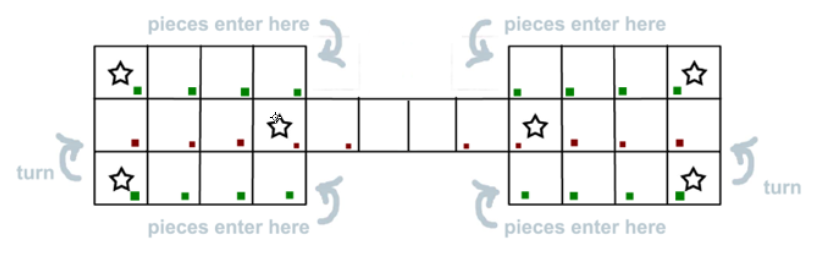
I decided to make Ur a 4 player game by changing the board so that the players get on at each end of the board and have to travel across a one lane bridge before getting off at their opposite base, what i found after playing the iteration is that there was almost two different games of Ur going on until people started getting to the middle bridge this meant that where there would usually be a lull in the action there wasn't anymore as the two people who won their respective fights then fought in the center and if no fights happened at the start there would be an even greater fight in the middle of the board. Overall i feel this iteration worked well as it made the game much more enjoyable as you could play it with more friends and have more battles, the iteration did what i set out for it to do which was to make the players interact more it also slowed the game down a bit so that all of the games weren't super quick due to having to wait for more people to take their turn and also more fighting in the middle of the board stretched the games out even further. Overall i really enjoyed this iteration.
Monday, 9 March 2015
British museum trip
Today we went on a class trip to the British museum, we spent the day looking at the various ancient games that the museum had on display that we had been learning about through the course of the first term. The game i was most looking forward to seeing was The Royal Game of Ur as this is the game i had most enjoyed playing in lessons and i thought it would be cool to see it in its original form.
Unfortunately the original version of The Game of Ur was not on display as the museum had loaned it out to another museum so that that they could have it on display.
We were shown around the museum by a rather interesting man called Irving Finkel who is a scholar and curator of the museum and a very knowledgeable man when it comes to ancient games, having Finkel show us around the displays the the trip as a whole more enjoyable as he gave great insight into the games we looked at.
Overall the trip was very enjoyable and being able to see the games we had played in class in their original forms as really cool.
Unfortunately the original version of The Game of Ur was not on display as the museum had loaned it out to another museum so that that they could have it on display.
We were shown around the museum by a rather interesting man called Irving Finkel who is a scholar and curator of the museum and a very knowledgeable man when it comes to ancient games, having Finkel show us around the displays the the trip as a whole more enjoyable as he gave great insight into the games we looked at.
Overall the trip was very enjoyable and being able to see the games we had played in class in their original forms as really cool.
Games Britannia: “Dicing with Destiny”
Today we watched the first part of a documentary called Games Britannia that dived into the history of board games. It focused on the origins of different ancient games and the effects they have had on different cultures over the years.
The presenter of Games Britannia was Benjamin Woolley who started the documentary by explaining how he had grown up with board games and some of the memorable experiences he has had based around them.
Benjamin investigates how the instinct to play games is both as universal and elemental as language itself. The episode discusses how Ancient and medieval games were not just fun, but a fundamental, and significant part of military tactician (It was used to train upcoming leaders in battle formations and tactics). In the Middle Ages games revolved around spirituality but this spiritual element in games began to be lost as gaming became increasingly associated with gambling. Dice and card games abounded, but a moral backlash in Victorian times transformed games into moral educational tools.This was also the era in which Britain established the world's first commercial games industry, with such classics as the Staunton Chess Set, Ludo and Snakes and Ladders leading the way, all adaptations of original games from other countries.
Wednesday, 26 November 2014
Ancient Games
Over the past few weeks, every Thursday we have been getting our hands on some ancient games, the first of which was Senet (The game of 30 squares) and The Royal Game of Ur (The game of 20 squares).
The Royal Game of Ur is a race game in which each player has to get all of their counters onto and then back off of the board, while being chased by their opponent, the way in which the two players can reset the position of each others counters by landing on the same square meant that the two players had to use strategy to get to the end of the board making the game fun and competitive.
Senet shares many similarities with Ur as it is a race game in which each player has to get their counters from one end of the board to the other and then off, however in Senet their are certain ways that players can block the other player from advancing along the board, such as by having three spaces occupied in a row.
Overall I found both games relatively fun to play, although I do feel that some of the rules in both games could do with a slight tweak to both make the rules clearer to the players and also to make the game better overall
The second game we played was Duodecium Scripta which is a two player racing game, played with 15 pieces of their colour choice, plus three six sided dice. The game starts with the players pieces off the board and build up in each players starting location, they can't move out of the home place in the middle until you have filled and stacked the board, once this starting row is filled then the player may move up to the top right of the board and move left along the top of the board and then once that is done down to the bottom and move right till the final phase of the game where they must roll the exact number to get off of the board. The only problem with the games was that it had a mechanic that allowed players to stack counters and move the stack as if it was one counter, this meant that all one player had to do was get all of their counters in one huge stack and race to the end, defeating the object of having multiple counters.
Lastly we played Tablut which is again is a two player game but this time it isn't a race game Tablut is a game with each player being either white or black, white has to protect the king and get him to the corners of the board and black have capture the king by surrounding him on all sides. This makes the game compelling from the idea of movement on the board however king will more likely win then lose due to 1 piece movement and how you are forced as black to get 4 pieces around, when I say you can win with nothing but a king due to the movement style of rooks from chess, because of this the king can run away unless boxed into 2 or 3 boxes and then crushed slowly by the black team.
SissyFight 2000
Sissyfight 2000
This was the game played in Robs lecture last Friday. The game involved using a set of cards (Team, Defend and Solo) to either attack one of your opponents or defend yourself you also got a set of colours, one of which you take for yourself and the others of which indicated the player you wanted to attack, So one of the main mechanics, is this hidden information factor, as players only know what card they have picked and who they are going to be attacking, any successful attacks/ defends get a set deduction from their counter pile, this mechanic leads to players trying to team up with each other to try and mount an attack on someone else or double bluff someone and then go attack someone else, creating a sense of backstabbing and tension.
We played three games before we went on to iterate the game, our first iteration was to add a mechanic that allowed on player to use a certain card so that any other damage done to a player would be doubled, this created an even stronger sense of people teaming up, as it ended up that everyone just tried to form alliances to get someone out of the game as quickly as possible, our second iteration was to add another colour card that when used would do damage to every other player in the game however if more than one person used the card only the people that used that card would take damage, this lead to people just trying to use it every round and the game ending very quickly
My thought on the game is that I didn't really enjoy it, this is mainly due to the fact that I was for the most part, the person that was being targeted at the start of every game, mainly due to the friends I was playing the game with, haha
This was the game played in Robs lecture last Friday. The game involved using a set of cards (Team, Defend and Solo) to either attack one of your opponents or defend yourself you also got a set of colours, one of which you take for yourself and the others of which indicated the player you wanted to attack, So one of the main mechanics, is this hidden information factor, as players only know what card they have picked and who they are going to be attacking, any successful attacks/ defends get a set deduction from their counter pile, this mechanic leads to players trying to team up with each other to try and mount an attack on someone else or double bluff someone and then go attack someone else, creating a sense of backstabbing and tension.
We played three games before we went on to iterate the game, our first iteration was to add a mechanic that allowed on player to use a certain card so that any other damage done to a player would be doubled, this created an even stronger sense of people teaming up, as it ended up that everyone just tried to form alliances to get someone out of the game as quickly as possible, our second iteration was to add another colour card that when used would do damage to every other player in the game however if more than one person used the card only the people that used that card would take damage, this lead to people just trying to use it every round and the game ending very quickly
My thought on the game is that I didn't really enjoy it, this is mainly due to the fact that I was for the most part, the person that was being targeted at the start of every game, mainly due to the friends I was playing the game with, haha
Wednesday, 12 November 2014
Game Classification
On Wednesday we learnt about how to define video games and how to categorize them.
We looked at the studies of James Newman who referred to Roger Caillois who came up with the idea of putting games into two main categories Paidia and Ludus.
Paidia can be simply explained as, “play” for pleasure
Ludus is defined as more constrained by rules, with a clear outcome (E.g. “Winning”)
He then furthered that by bringing in the following:
Agon: Competition - a competitive multiplayer game
Alea: Chance, Randomness - A gambling game or equivalent
Ilinx: Movement, Vertigo: - Outdoor sports, skiing, skateboarding
Mimicry: Simulation, Role-Play – Cinema
Games that came to mind when I thought of Ludus were board games as they have a clearly defined set of rules that have to be followed for the game to function properly. Board games also have an element of competition to them as most of them involve players playing against each other to see who can get to the goal first.
World of Warcraft is a game that offers the player a huge sandbox world to play in and gives people the freedom to do what they want, whenever and how they want to, which is why I feel like it has elements of Paidia however it also has elements of Agon with the competitive PvP, Alea as the loot system is based on a roll between 1 and 100.
Wednesday, 15 October 2014
Bibliographies
Schell, J (2008) The Art of Game Design: A Book of Lenses, CRC Press, Florida
Chey, J (2003) "System shock 2" in Grossman, A. (ed) Postmortems from game developer insights from the developers of the Unreal tournament, black & white, Age of Empires and other top selling games, San francisco, CMPBooks, pp 5-12
Chey, J (2003) "System shock 2" in Grossman, A. (ed) Postmortems from game developer insights from the developers of the Unreal tournament, black & white, Age of Empires and other top selling games, San francisco, CMPBooks, pp 5-12
Sunday, 5 October 2014
A bit about me
What is the title of the book (fiction) you are currently reading or what is the title of the last fiction book you read ?

I am not currently reading any fiction books at the time of writing this blog, this is in part due to the fact that there is not a book i have seen as of late that has caught my attention enough for me
to sit down and read it. One of the last fiction books that i read was Of Mice and Men in secondary school as part of my GCSE in English, when i initially started to read the book as part of the work i didn't really get engaged with it and i started to find reading it boring, however once i started to learn more and more about the book and some of the hidden meaning in the book i started to really appreciate how good the book is.
I am not currently reading any fiction books at the time of writing this blog, this is in part due to the fact that there is not a book i have seen as of late that has caught my attention enough for me
to sit down and read it. One of the last fiction books that i read was Of Mice and Men in secondary school as part of my GCSE in English, when i initially started to read the book as part of the work i didn't really get engaged with it and i started to find reading it boring, however once i started to learn more and more about the book and some of the hidden meaning in the book i started to really appreciate how good the book is.
What is the title/topic of the book (non-fiction) you are currently reading or what is the title/topic of the last non-fiction book you read ?

Since becoming invested in the idea of games design and becoming a games designer i have started to read non-fiction books on the subject of games design, one i have recently started reading after being recommended it by Dave Pimm (one of my lecturers) is Jesse Schells The Art of Game Design which i have found to be a really good read.
Since becoming invested in the idea of games design and becoming a games designer i have started to read non-fiction books on the subject of games design, one i have recently started reading after being recommended it by Dave Pimm (one of my lecturers) is Jesse Schells The Art of Game Design which i have found to be a really good read.
What is the last live performance (music, drama or dance) you attended ?

The last live performance event i attended was V Festival in Chelmsford a few summers ago, me and some friends from school went there. I was really looking forward to seeing Ed Sheeran live as i was listening to his music a lot at the time, i really enjoyed going to V Festival and seeing all the Bands and Singers that i listened to a lot in person. The only downside to the weekend was that it was two of the hottest days of the year without much shade so you got very hot very quickly.
The last live performance event i attended was V Festival in Chelmsford a few summers ago, me and some friends from school went there. I was really looking forward to seeing Ed Sheeran live as i was listening to his music a lot at the time, i really enjoyed going to V Festival and seeing all the Bands and Singers that i listened to a lot in person. The only downside to the weekend was that it was two of the hottest days of the year without much shade so you got very hot very quickly.
What is the title of the last film you saw either at the cinema/ online or watched on DVD ?

The last film that i watched was actually only last night as of writing this, me and some of my flat mates and their friends all decided to watch a film at our flat, we decided to watch 28 Days later which was a film that i hadn't seen until then. apart from 28 Days later i don't really watch many films i usually tend to prefer to watch streams of games of watch TV programs on things like BBC iPlayer and 4OD
The last film that i watched was actually only last night as of writing this, me and some of my flat mates and their friends all decided to watch a film at our flat, we decided to watch 28 Days later which was a film that i hadn't seen until then. apart from 28 Days later i don't really watch many films i usually tend to prefer to watch streams of games of watch TV programs on things like BBC iPlayer and 4OD
How often do you read a newspaper ? Which One ? Online or physical ?

I very rarely read the newspaper, the only time i do read a newspaper would be if there is one in the front room at home and i might read that in the evening or i might pick one up when i'm on the train, i only ever read physical newspapers and the paper woulds usually be a local newspaper.
I very rarely read the newspaper, the only time i do read a newspaper would be if there is one in the front room at home and i might read that in the evening or i might pick one up when i'm on the train, i only ever read physical newspapers and the paper woulds usually be a local newspaper.
Which art gallery / museum / exhibition did you last visit ?

Not too long ago i visited the Science Museum London, i have visited the Science Museum London a number of times as science is something that has always interested me and i like looking around all of the old cars they have on display and looking around either space exhibition. I also find all of the technology that they have on display (some of which is useable by the public) really interesting to use and find out about.
Not too long ago i visited the Science Museum London, i have visited the Science Museum London a number of times as science is something that has always interested me and i like looking around all of the old cars they have on display and looking around either space exhibition. I also find all of the technology that they have on display (some of which is useable by the public) really interesting to use and find out about.
How many hours a week do you spend playing video games ?

I generally spend anywhere from 15-25 hours a week playing games usually playing counter strike, however this number can be even lower when i have something that i need to get done such as work for college. I have recently started to play more different games rather than just spend hours on a single game. At the moment i have a couple of favorite games that i am playing which are Escapists which is a top-down gamed based on escaping from prison and the player has to find one of many different ways to escape and Rimworld which is another top-down game that is based on a group of survivors that all have different skills such as building and hunting, this game uses randomly generated encounters to produce raids on the camps that you make that you have to defend using your group of survivors
I generally spend anywhere from 15-25 hours a week playing games usually playing counter strike, however this number can be even lower when i have something that i need to get done such as work for college. I have recently started to play more different games rather than just spend hours on a single game. At the moment i have a couple of favorite games that i am playing which are Escapists which is a top-down gamed based on escaping from prison and the player has to find one of many different ways to escape and Rimworld which is another top-down game that is based on a group of survivors that all have different skills such as building and hunting, this game uses randomly generated encounters to produce raids on the camps that you make that you have to defend using your group of survivors
How many hours a week do you spend playing games other than video games ?

I spend very little time playing games other than video games, however i do like playing card games so i will occasionally play card games with friends and family. Although i don't often play non video games when i do occasionally play then i tend to spend many hours playing card games.
I spend very little time playing games other than video games, however i do like playing card games so i will occasionally play card games with friends and family. Although i don't often play non video games when i do occasionally play then i tend to spend many hours playing card games.
Subscribe to:
Posts (Atom)